
How Kibo Africa Is Reinventing Mobility with Durable Off-Road Motorcycles and a New Electric Motorcycle Line
In this interview, Kibo Africa’s Managing Director, Peter Schokker, discusses the company’s transition into a new phase of leadership and outlines a bold, market-driven strategy to strengthen Kibo Motorcycles Kenya and expand across East Africa. He highlights how the company is moving from a purely product-oriented approach to a deeper focus on market insights, customer needs, and motorcycles suitable for East African terrain, ensuring that every model reflects durability, reliability, and robustness.
A major part of the new strategy is the expansion of the motorcycle portfolio. Kibo is working to introduce a 125cc motorcycle Kenya to meet the growing demand from government motorcycle tenders Kenya, corporate motorcycle fleets, and SME users seeking fuel-efficient motorcycles. The company is also exploring upgraded options within the off-road motorcycles Kenya, utility motorcycles Kenya, and adventure bikes East Africa categories, ensuring broader choice alongside the established Kibo K160 and Kibo K250 models.
Peter explains that Kibo is tapping into an entirely new segment by developing youth motorcycles Africa, including models for children, teenagers, and junior riders. He highlights the strong potential in youth off-road riding, school circuits, and family activities, noting customer demand for safe and reliable junior bikes.
The conversation also delves into Kibo’s long-term innovation strategy, particularly its work on electric mobility East Africa. Kibo is finalising its first Kibo electric motorcycle, developed in partnership with an experienced manufacturer capable of providing a full motorcycle supply chain Africa and comprehensive after-sales service. With markets such as Rwanda already pushing for electric mobility, Kibo aims to launch durable and reliable electric motorcycles in Africa that can compete directly with internal combustion engine models.
A complete restructuring of the supply chain is underway, reducing dependence on dozens of suppliers and enabling faster delivery times for large orders—now just two to three months. This shift greatly strengthens the after-sales service in Kenya, improves motorcycle spare parts availability, and enhances Kibo’s ability to scale across new countries.
Peter outlines plans for geographic and operational expansion, targeting East Africa, Central Africa, and beyond through partnerships, joint ventures, and dealer networks. He also emphasises the search for investment partners to support working capital, expansion into new markets, and the development of the electric motorcycle range.
Throughout the interview, he reinforces Kibo’s identity as a socially grounded African company, committed to motorcycle assembly in Kenya, skills transfer, and technical training. In the coming years, Kibo aims to boost brand visibility, strengthen digital presence across multiple African markets, and position itself as the leading provider of off-road bikes, adventure bikes, kids bikes, motorsports bikes, and utility bikes designed specifically for African roads.
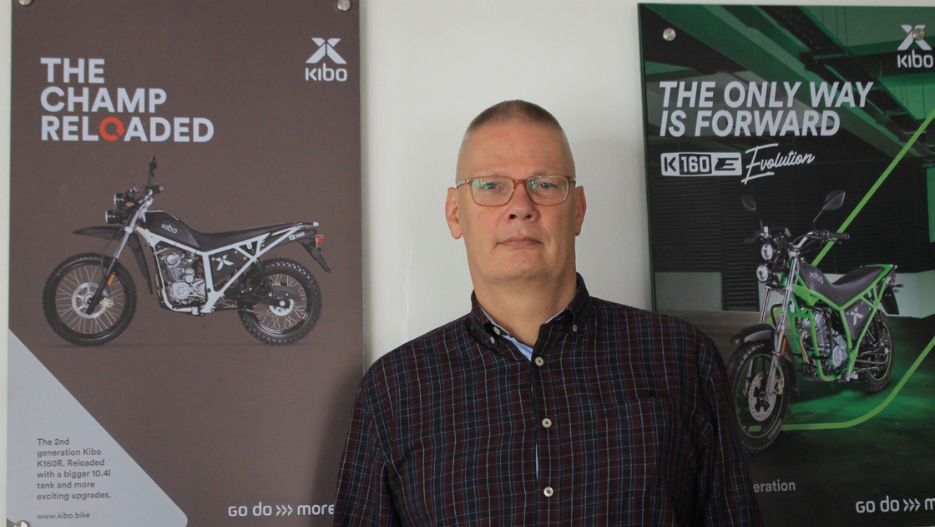
Kibo Africa has recently entered a new chapter with a change in ownership. How would you describe this transition and what it represents for the company’s future direction?
Since establishing the company in 2013, Huib and his team have designed the motorcycles, developed prototypes, introduced them to the market, expanded the team, and created different models, all while ensuring that the human aspect remained central. He has consistently taken very good care of his employees, and I believe everyone who has worked at Kibo is grateful for his leadership and the strong social values he brought to the company.
Therefore, I would like to express my sincere appreciation for everything he has done for the company and for its people. His contribution has truly been exceptional.
The new chapter is geared towards amplifying his dream which was to build a strong team that provides safe and reliable mobility solutions. I’m very excited with what the future holds for Kibo.
Your new leadership has also reshaped the business case, mission, and values. What key strategic shifts are you introducing under this new vision?
From the start, we have examined how we want Kibo to develop. Historically, Kibo operated as a product-oriented company. The focus was on creating a product and thereafter identifying markets. Although work was done in both areas, our intention is to place stronger emphasis on markets and customers.
We have analysed the type of motorcycle that Kibo offers, particularly within the off-road and utility segments. We have identified key customer groups, including government, corporates, small and medium-sized enterprises, and individuals. Through this process, we recognised that we were missing a 125cc model. Government and corporate clients often prefer motorcycles with lower fuel consumption, and a 125cc model would complement our existing 160cc model. We are therefore working with one or two partners to explore what they offer and to determine whether we can customise an existing design to create a Kibo-standard motorcycle.
We are also assessing the all-terrain segment. We currently have the K250, but we are exploring options for a more powerful adventure motorcycle. We are working with partners who have a broad range of models that can be adapted to our standards. This will allow us to offer customers a greater variety of options while maintaining the qualities associated with Kibo: durability, reliability, suitability for East African terrain, and overall robustness. Instead of focusing solely on two or three models, we intend to serve a wider customer base by providing more choice and aligning development more closely with customer needs.
Another strategic shift is exploring new customer categories. There is significant potential in the youth segment, including motorcycles for children, teenagers, and junior riders. This market is undervalued and presents meaningful opportunities. We know there is a small circuit already in place, mainly focused on competition, but we also see opportunities in schools and in areas where parents are developing spaces for children to be active. Rather than spending time solely on digital activities, children can engage in a sport that supports physical development and confidence.
Recently, a customer brought in his motorcycle for servicing and mentioned that he wanted to buy a motorcycle for his children because they share his passion for riding. At the moment, there are limited options available. It is encouraging to see a parent and child riding together, and we want to support that experience. We aim to work not only with individual parents, but also to explore small circuits, potential collaborations with schools, and broader youth engagement in off-road riding. It is an exciting area with considerable growth potential.
Have you conducted any market research to understand customer needs as you expand your product portfolio, and what are the key requirements in Kenya and the wider region?
We have not conducted a formal market study through a survey company. However, we have extensive field insights from our sales team, who speak directly with customers. While they promote our current models, they also listen to customer preferences and the reasons some customers may choose alternative options. This feedback provides us with valuable information.
Since last year, we have also worked closely with agents who sell our motorcycles, as well as with dealers, motorbike workshops, and repair and maintenance centres. These partners provide us with continuous signals regarding what customers are requesting and where the gaps are. In addition, several members of our team have many years of experience and already have strong insights into market needs. Historically, the focus was on designing our own motorcycles. Our approach now is to identify partners who already have suitable models and then determine whether we can adapt these to meet Kibo standards of durability, reliability, and suitability for East African terrain.
This does not mean that our current models are not relevant. Instead, we are seeking additional models to serve a broader customer base, increase our reach, and improve service delivery. One clear example is the shift in government tenders. Previously, tenders focused on 175cc motorcycles. They now concentrate on 125cc models, which we currently do not offer. This makes it more difficult for us to supply government clients. Introducing a 125cc motorcycle would open opportunities not only with the government but also with corporates, where fuel consumption is a major concern. A fuel-efficient model within that range would therefore be very valuable.
Through these developments, we aim to strengthen our competitive position by aligning our portfolio more closely with specific market needs in Kenya and the wider region.
How does electric mobility fit into your long-term growth strategy for East Africa?
More countries in the region are increasingly focusing on electric mobility. Rwanda, for example, has already restricted the use of internal combustion engine motorcycles, indicating that the market for electric motorcycles will continue to grow. We are currently developing an electric Kibo model with a partner. This includes the battery, powertrain, drivetrain, and other components. We already have a prototype that is not yet ready for the market, but it is close. It is a typical Kibo motorcycle, but electric, and even stronger in performance than our current engine range. This is a very exciting development.
Our partners have also developed several electric models. We are still analysing which specific markets these models can serve. For the electric Kibo motorcycle, we have clearer insights because customers have already expressed interest in an electric version of the Kibo they know. For other electric models, we are receiving increasing interest from customers, non-governmental organisations, and government departments. The general sentiment is that Kibo motorcycles are trusted for their durability and reliability, and there is now a growing demand for electric alternatives. We expect to have an electric Kibo available within the next few months, and we are also considering other electric products to broaden our offering.
In terms of geographic expansion, we are discussing with our partners the possibility of securing exclusivity for East Africa and potentially other African regions. They are willing to support us, as we already have small operations in Uganda and the Democratic Republic of Congo. If we significantly adjust our supply chain, expanding into additional countries will become much easier. There is a meaningful opportunity to work with local partners, investors, and joint ventures in various African markets to introduce Kibo motorcycles more widely.
Our updated supply chain gives us greater flexibility in how we develop and modify motorcycles. The traditional Kibo model is highly engineered, which makes modifications more time-consuming and complex. Our new partner can implement changes more quickly, making it easier to adjust motorcycles for different terrains. While terrains across African countries are not identical, they are similar enough that a base motorcycle can be adapted to suit local conditions. This increased flexibility enhances our ability to serve markets beyond Kenya and to expand across the continent.
Changing the supply chain and working with more or less one partner instead of relying on approximately thirty different suppliers will make the aftermarket process significantly easier. Services and spare parts become a much more straightforward operation compared to what we have in place now. In addition, we have a very experienced partner who understands the entire process and has already sold products in other countries. This means they can provide us with comprehensive after-sales service and support.
This support is extremely valuable because, as I mentioned previously, managing spare parts and the supply chain behind them is complex. Any motorbike manufacturer will confirm that it is one of the most challenging aspects of the business. Having a partner with deep experience and an already-established supply chain makes our work easier and ensures that our customers receive the correct level of service. That is a major advantage of collaborating with an experienced partner who already has the full supply chain structure in place.
As you launch this new era, how important is strengthening your visibility across digital platforms and online media, and are you changing your approach in this area?
Strengthening our visibility remains a priority, and we have already made improvements. However, we have not yet reached the level required. We have received offers from commercial companies to assist with advertising and social media outreach, but we are focused on collaborating with the right partners, on the right channels, and at the right events.
As we expand into other countries, it is essential to include an international component. An influencer in Kenya, for example, will not have the same impact in Nigeria or Senegal. Additionally, we need to finalise preparations with our partners to ensure that the bikes are fully ready for these markets.
One of the major advantages of our updated supply chain is a shorter turnaround time. Customers can receive their motorcycles within two to three months, whether they order 100, 200, or 300 units. Previously, the process took significantly longer. Before we fully advertise this shift in product portfolio, customer focus, after-sales improvements, and our gateway approach to the African market, there are several operational steps we need to complete. Communication and marketing are critical components, and we are continuing to refine this area to ensure effective visibility and outreach.
What type of investment partners are you seeking, and what opportunities does this new phase create for them?
We are seeking partners to support the international component of our growth. This includes setting up operations in different countries, which can take various forms, such as joint ventures, establishing a new entity, or contracting with existing dealers. There are multiple options to structure these partnerships depending on the local context.
In addition, we require working capital. In this industry, motorcycles and spare parts typically need to be prefinanced before sales. Working capital can be provided in different forms, including loans, equity participation, or any solution that ensures funds are available to purchase stock. This enables us to maintain inventory in-country and meet customer demand efficiently.
Finally, the development of electric motorcycles presents significant investment opportunities. While some countries, such as Rwanda, are already ready for electric mobility, others, including Kenya, are at an earlier stage, and several African markets still rely entirely on petrol motorcycles. Developing the right electric models for each market requires substantial effort, investment, and communication. Currently, the Kibo range does not include electric motorcycles, so there is considerable potential to expand into this segment. This requires both the development of appropriate models and the effort to establish customer adoption.
What targets have you set for yourself in the medium term, and what objectives do you aim to achieve over the next two years?
Now I have to be a bit political. I do not want to tie myself too much to numbers, because then you are going to come back to me in two years’ time and say, ah, you told me that. I do not know. I think in Kenya we have a number that we believe we can achieve, but it is really difficult to name numbers, and I do not want to do that. Perhaps not numbers, but objectives in your strategy. You have written down your strategy. What aims do you focus on, not in terms of numbers, but more qualitative?
We still want to be the bike supplier for off-road bikes, adventure bikes, kids bikes, motorsports bikes, and utility bikes in the African terrain, and we want people to recognise Keeble as the brand to go to. That is our goal. Slowly, in Kenya, the brand name exists, but it can be strengthened considerably. That is something we are going to work on, and we aim to have significantly higher brand awareness in Kenya, let alone in other countries. In the next few years, we want to enter a couple of markets that are quite interesting in terms of size. If we can achieve half a per cent or one per cent of the markets in a large country, that would be very significant in terms of delivery of bikes, brand awareness, and profits. Expanding the portfolio, creating more brand awareness, and entering different countries are key objectives.
Kibo has always been a social company, and we want to maintain that. We do not want to be solely a distribution agent that sells bikes. We want to retain assembly capability and customer service. We want our partners to come to Kenya and other countries where we will operate to train our local staff, ensuring that technical skills and knowledge are transferred to the teams we have and will have in the future. It must remain an African company. That is why the majority of shareholders are Kenyan. I am a minority, so to speak. It must be, as much as possible, a local effort. This requires training people so that they can take pride in their knowledge and skills. For the bikes that we put on the streets, ensuring they are quality bikes is very important to us.