
Silafrica Kenya’s Akshay Shah on Sustainable Packaging and the Future of the Circular Economy in Africa
In this in-depth interview with Akshay Shah of Silafrica Kenya, the discussion explores how sustainable packaging Kenya, circular economy Kenya, and Extended Producer Responsibility (EPR) are becoming central to Africa’s environmental transition. Speaking ahead of COP30, Akshay explains the critical role of sustainable packaging in advancing global climate and circular economy goals, stressing that COP30 must focus on implementation rather than new declarations. He highlights that COP30 plastics discussions and global EPR frameworks are pushing packaging manufacturers to adopt recyclable, returnable and reusable plastic packaging, reduce material usage, and shift from fossil-based plastics to post-consumer recycled plastic.
Turning to Kenya, he notes that the country has taken significant steps with the plastic bag ban, the establishment of KEPRO Kenya, and the introduction of the Sustainable Waste Management Act, yet enforcement remains a major challenge. Akshay emphasises that without fully functional Material Recovery Facilities Kenya, the region cannot achieve a true circular economy, because segregated waste cannot be sorted effectively. He explains that many recyclers in the Kenya recycling sector and across East Africa are struggling financially due to shortages of high-quality recyclable material, caused by the absence of operational MRFs.
The interview outlines why MRF investment Africa is urgently needed and why polluters must contribute via EPR fees. However, current legislation limits KEPRO from providing seed capital, creating a structural gap. Akshay argues that although millions of dollars in impact investment flow into recycling plants, the bottleneck lies upstream: Africa must prioritise funding Material Recovery Facilities, which cost roughly USD 150,000–200,000 to establish. These facilities would create green jobs, stabilise supply chains, and strengthen circular packaging Africa. He identifies the informal, cash-based dumpsite economy as a major obstacle and stresses the need for cultural change, public awareness, county-level political will, and effective enforcement.
Akshay also discusses Silafrica Kenya’s sustainability targets, explaining why post-consumer recycled content fell from 32% to 7% in 2024 due to shortages of suitable material. He outlines Silafrica’s renewed goal of reaching 25% by 2030, driven by support for recyclers, stronger Producer Responsibility Organisation Kenya systems, and the expansion of recyclable plastic packaging solutions. Silafrica is innovating with returnable and reusable crates for fruit and vegetable exports, replacing wasteful single-use corrugated boxes, and identifying linear-use materials that can be substituted with durable alternatives.
Finally, Akshay highlights significant opportunities for East African manufacturing competitiveness. With low-cost solar energy, automation, and Industry 4.0 technologies, the region is well positioned to become a global supplier of sustainable packaging Africa and export-ready solutions. He also calls on impact investment and development partners to redirect funding from recycling plants toward MRF development, which would unlock the entire value chain and accelerate Africa’s shift to a genuine circular economy.
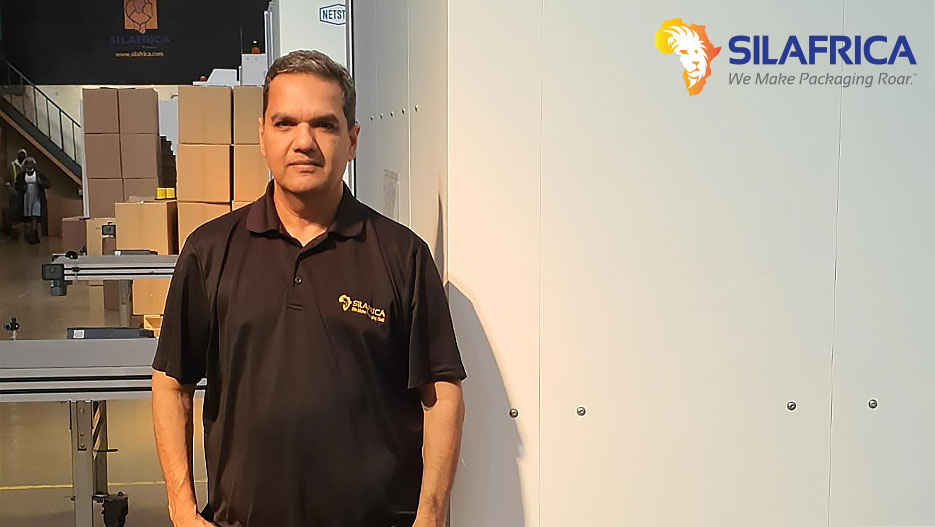
In the context of COP30, what role does sustainable packaging play in advancing global climate and circular economy goals?
The COP30 is taking place this month in Brazil, bringing climate change and circular economy efforts into sharp global focus. When we look at the history of the COP, the first question to answer is how effective it has been. The COP has achieved a few landmark milestones, such as the Paris Climate Accord. It is working to build global consensus on how we address climate issues, and within that sits the topic of plastics and Extended Producer Responsibility (EPR). I would say the COP has been successful in raising awareness and securing some agreements, but it has not been successful in terms of implementation.
What is different this time in Brazil is the shift in emphasis towards implementation rather than continued discussion, which is a welcome area of focus. There is no end to conversations about what needs to be done, and for decades we have seen continuous dialogue on climate change while action on the ground has been delayed. I am encouraged by the focus on implementing existing commitments rather than creating new ones.
Within the packaging sector, COP30 will concentrate on mechanisms that support a circular economy, particularly through the EPR model. This is important because some regions do not regard EPR as the standard approach for transitioning to a circular economy, which is understandable, as not every country will follow the same pathway. However, evidence shows that wherever EPR has been implemented, it provides a fair, equitable, and transparent mechanism for transferring capital from a linear economy to a circular one. Funding flows into waste collection, waste sorting, and recycling, ultimately creating a new source of raw material. Instead of relying on fossil-based plastics, we begin to use recovered plastics, which is a significant step forward.
The second benefit of the EPR model is its influence upstream. It discourages the production of non-recyclable packaging by applying eco-modulated fees. The more challenging a packaging material is to collect, sort, or recycle, the higher the fee. In some cases, these fees exceed the cost of the material itself. This is advantageous because it incentivises packaging manufacturers and users to redesign packaging so that it is recyclable, returnable, and reusable. As they do this, it becomes important to reduce material usage and create additional primary or secondary applications for the packaging before it is sent for recycling. That is the direction we would like to see.
In summary, the role of COP30 is to move beyond discussion of new initiatives and focus on making the EPR model function effectively.
Now, turning to Kenya, what can you tell us about what is expected to happen in the country and for the country within this broader transition?
The good news for Kenya, East Africa, and the African continent is that no one is waiting for a global treaty. No one is waiting for the COP or the INC to make a decision before aligning with it. The regional economy has its own value chain. Plastic raw materials are imported into the region, but once these materials enter the local economy, there is every reason to ensure they remain within a circular system. This depends far more on local legislation and its implementation than on any global treaty. Global treaties tend to follow, while legislative development and implementation in Kenya have progressed well.
To break it down, Kenya first raised awareness and then introduced measures such as the ban on plastic bags in 2017. A few years later, KEPRO, the Kenya Producer Responsibility Organisation, was formed. Mandated by the Ministry of Environment, it was established to advance the circular economy for packaging through the implementation of Extended Producer Responsibility (EPR) models. This began as a voluntary pilot to determine whether it could create a functional circular system, and if successful, guide the shift from voluntary to mandatory requirements.
In 2022 and 2024, two important pieces of legislation were enacted: the Sustainable Waste Management Act Part 1 and Part 2. Kenya now has all the necessary legal structures in place, but the challenge lies in enforcement. Enforcement occurs at the county level rather than the national level, and no county has achieved full compliance. This creates a chicken-and-egg situation.
For example, the Sustainable Waste Management Act requires waste producer, individuals, businesses, and institutions to segregate waste at source. Segregated waste must then be collected by a licensed waste collector, and recyclable waste must be taken to a designated Material Recovery Facility (MRF), not to a dumpsite or landfill. The MRF sorts and compresses the waste into various material fractions, which are then supplied to recyclers as raw material. It is a well-designed system, but the challenge is that Kenya currently has no operational MRFs. Implementation becomes extremely difficult without the necessary infrastructure.
Kenya now needs seed capital to establish MRFs. These facilities would create significant green jobs and strengthen the sustainability sector. MRFs would also generate the supply of recyclable material required to sustain recycling businesses. Although many companies have invested in recycling for plastics, paper, glass, and metal, most recyclers are not performing well financially. The primary reason is the lack of suitable recyclable material, which directly results from the absence of MRFs.
How can Kenya raise the capital needed to establish Material Recovery Facilities, and should polluters be obliged to contribute?
The law is already in place. The Extended Producer Responsibility (EPR) mechanism requires polluters to contribute funds based on a per-kilogram EPR fee. For every kilogramme of paper, plastic, metal, or any other packaging material that a packaging user places on the market, they must pay a specified amount to KEPRO. KEPRO can then use these funds to support recyclers, waste collectors, and waste sorters. A Material Recovery Facility (MRF) is categorised as a waste sorter.
However, KEPRO cannot provide seed capital. KEPRO can offer subsidies to MRFs, but it cannot supply the initial investment required to establish them. There is a structural limitation on what a Producer Responsibility Organisation can do with its funds. Therefore, seed capital is needed to initiate a few MRFs.
The Government of Kenya is supporting MRF development by providing land. The investment required is therefore to take a few acres of government-allocated land and construct a simple structure equipped with conveyor belts, sorting bins, safety gear, and baling presses. The initial capital required to begin operations is approximately USD 150,000 to USD 200,000. This is not a significant amount of capital.
The issue is that a substantial amount of funding whether grants, debt, or equity is flowing into recycling. The challenge with this approach is that it places the cart before the horse. Instead of directing funds primarily towards recycling plants, capital should be directed first into MRFs, which generate the supply of material suitable for recycling. Once this supply exists, the recycling capacity that has already been developed can begin to generate a return on investment.
A significant portion of impact investment, impact funds, and impact grants needs to be redirected towards MRFs. The current pattern follows the usual approach: funding recycling initiatives, only to discover later that recyclers lack adequate material because MRFs were never established. Recycling is widely viewed as a green and appropriate investment, but when recycling plants fail five or ten years later, the underlying issue is often that they did not receive sufficient material due to the absence of MRFs.
Why does funding for Material Recovery Facilities (MRFs) receive so little attention?
Many people do not understand the need to fund Material Recovery Facilities (MRFs). The reason is that MRFs are not well publicised and do not receive adequate attention. While USD 200,000 is a relatively small amount compared to the funds directed into recycling, this investment has not yet been fully effective due to a dysfunction in understanding the waste value chain.
Recycling is widely understood because it receives significant attention and positive narratives. However, when someone places waste in a garbage bin, they often believe that this constitutes recycling. In reality, this is only the beginning. Even if waste is segregated, it is not always maintained separately through the collection and sorting process. Segregated waste is sometimes mixed during collection.
Another challenge is that waste is cheaper and easier to send to a dump site or landfill. An informal, exploitative, cash-based economy exists around this process. This system operates without taxation and can be compared to a mafia-like structure, with vested interests that resist change.
In Africa, the concept of MRFs is still new. There is a need to shift the perspective from sending waste to landfills or dump sites to directing all waste to MRFs. Landfills and dump sites should be eliminated. All recyclable waste should go to an MRF. Non-recyclable waste can also be processed at an MRF and then directed to other waste-to-energy processes, such as pyrolysis or incineration. Organic waste can be redirected to processes such as biogas production.
Is the challenge with MRFs primarily a communication and awareness issue, or are there other factors involved?
Communication is one part of the puzzle, but there is no silver bullet. Creating awareness and educating the public is important. However, this must be followed by legislation, which is already in place, a genuine will to enforce it, and investment to establish the necessary infrastructure to support enforcement. Communication alone cannot resolve the issue.
Transitioning from a linear to a circular economy fundamentally involves money. If MRFs were recognised as highly profitable businesses with good returns on investment, there would be no need to wait for grant funding or legislation. People would naturally invest in establishing these businesses. Creating one or two successful MRFs would demonstrate that they are profitable, employ many people, and contribute to environmental protection. This would illustrate the triple benefit of people, planet, and profit.
The key is to showcase tangible examples. Once one or two MRFs succeed, others will follow, similar to the FinTech sector in Africa, where profitability is evident and investment flows without waiting for donor or grant funding. MRFs could become a comparable opportunity, demonstrating that they are both viable and impactful businesses.
Are there examples of successful Material Recovery Facilities that Kenya can learn from?
Currently, there are no operational MRFs in this part of the world. Europe, however, provides examples of functioning systems. For instance, in London, residents take certain types of waste that are not collected by garbage trucks, such as furniture, clothing, or appliances, to designated centres. These centres have separate bays for different materials wood, glass, clothing, appliances and at the bottom are large containers to receive the sorted waste.
The sorted waste is then processed further on conveyor belts, where it is manually sorted, compressed, and sold to recyclers. The recyclers are willing to pay a higher price because the initial sorting has already been completed. This system solves multiple problems and represents a normal, well-functioning MRF model.
Establishing such a system in Kenya requires both cultural change and legislative maturity. While it may take time, it is achievable. The example of leapfrog technologies illustrates this potential. Mobile phones bypassed landline infrastructure, and Kenya now has Internet connectivity and speeds that are competitive with, and in some cases superior to, Germany. If such technological leapfrogging is possible, the same approach can be applied to waste management, making MRFs viable, profitable, and impactful.
What are the main obstacles preventing the effective establishment of Material Recovery Facilities in Kenya?
The major challenges can be understood as friction. Anything with low friction occurs more easily, while anything with high friction occurs less. The status quo where waste is collected and disposed of at dump sites has very little friction. Individuals, often women and children, work all day on dump sites without protection, recovering waste to sell to others for minimal pay. Despite being dangerous and exploitative, this system continues because it involves minimal resistance.
If Material Recovery Facilities become the alternative, offering a low-friction route for waste to flow, waste can move easily from households to MRFs, be sorted, and made available to recyclers. Money will then shift from landfills to MRFs, as it naturally flows toward low-friction channels. The key issue is therefore reducing friction in this alternative waste pathway.
There is no single obstacle. The greatest challenge is likely political will at the county level. Implementation depends on prioritisation by county leadership. It is not that MRFs are seen as a bad idea; rather, they require focus and commitment from local authorities to ensure they are established and functional.
What are Silafrica’s main goals for the next few years?
Back in 2020, when Silafrica became a global signatory of the Ellen MacArthur Foundation, the company set a target of using 40% post-consumer recycled plastic in total production. By 2023, Silafrica had reached approximately 32%, and it was expected that the 40% target would be met by 2025. However, in 2024, the percentage dropped from 32% to 7%.
The main reason for this decline was a shortage of post-consumer recycled plastic that met the required specifications, volume, and price to substitute virgin plastic. This shortage is directly linked to the lack of operational Material Recovery Facilities, which creates a bottleneck for recyclers and subsequently limits the supply available to manufacturers.
Another factor was the introduction of new circular packaging solutions, such as crates for vegetable and fruit exports designed to replace single-use corrugated boxes. These products initially require virgin material to meet quality specifications, but they are designed to be returnable and reusable. Once used, the materials become post-consumer and can be recycled into new packaging. Although the 2024 rate of 7% was below expectations, Silafrica anticipates recovery and has set a new target of 25% post-consumer recycled content by 2030. Achieving this will require supporting recyclers, promoting legislation for Extended Producer Responsibility (EPR), strengthening Producer Responsibility Organisations, and increasing the number of MRFs. Retaining value within the local economy also supports economic growth by reducing the need for imported virgin plastic and increasing disposable income for consumers.
The second focus is on innovation and expanding the innovation footprint. South Africa’s growth over the last 63 years has been driven by substituting environmentally harmful packaging with sustainable alternatives. For example, many years ago, beer and soft drinks in glass bottles were transported in wooden crates. Transitioning from wood to plastic crates required significant investment and education of customers and supply chains, but the outcome reduced breakage, improved return on investment, and created a more durable solution. Millions of trees were saved through this transition.
Silafrica aims to replicate this substitution model by identifying other linear-use materials that can be replaced with recyclable, returnable, and reusable plastic alternatives. This innovation will be expanded across existing manufacturing locations in Ethiopia, Kenya, Tanzania, and Mozambique, with the goal of transforming local and export packaging markets.
The third focus is leveraging East Africa’s competitive advantage in the context of global manufacturing shifts. Rising production costs and tariffs in other regions present opportunities for East African manufacturing. Silafrica operates a lean system, benefits from low-cost solar energy, high labour productivity, automation, and Industry 4.0 technologies. This positions the company as an ideal packaging manufacturer capable of supplying both local and global markets efficiently.
In summary, Silafrica’s goals for the next few years focus on increasing post-consumer recycled content, expanding innovation in sustainable packaging, and capitalising on East Africa’s competitive advantages to grow the business and positively impact the economy.