
Nana Asiedu, Director of Molders Group, on Affordable Modular Homes in Ghana, Prefabricated Housing Prices and Sustainable Construction
In this MarcoPolis interview, Nana Asiedu, Director of Molders Group, explains how affordable modular homes in Ghana could widen homeownership. The company manufactures locally adapted, thermally comfortable units for buyers who already own land. For anyone asking “How much do modular homes cost in Ghana?”, its one-bedroom modular house price in Ghana is $11,500, while a two-bedroom unit costs $23,000. Production takes three weeks to a month, followed by one-day installation. Asiedu discusses customisable modular houses for sale in Ghana, low-cost prefabricated houses in Ghana and energy efficient modular homes for tropical climates.
He outlines architectural design and construction services in Accra, steel fabrication, facilities management, modular office space solutions in Ghana, modern prefabricated vendor kiosks in Ghana, prefabricated washroom facilities in Ghana and modular security posts for commercial properties. He examines sustainable steel construction methods in Ghana, reusable steel building structures in Ghana and how modular construction reduces building waste. Projects include Parakuo Estates and Palm University, alongside affordable modular housing projects in Liberia, investment opportunities in modular housing in Ghana and plans for sustainable housing development across West Africa.
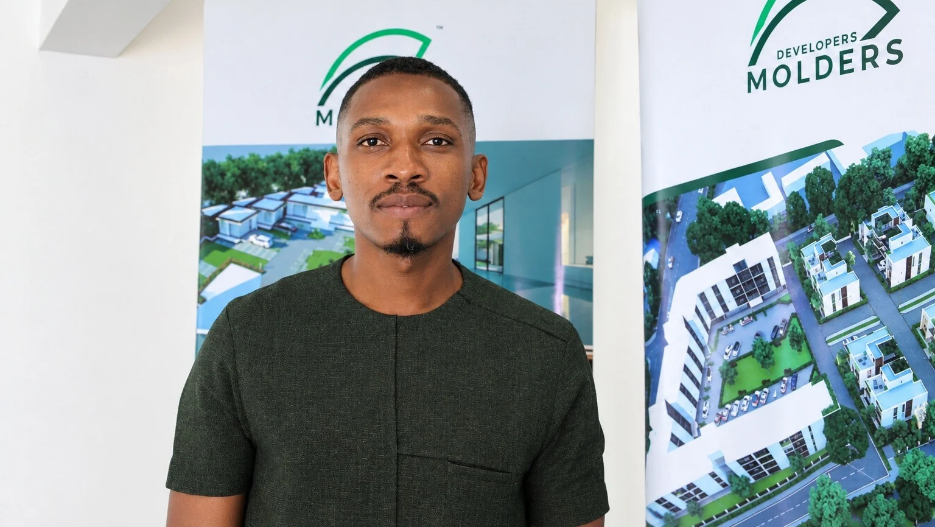
Could you please provide us with an overview of the company, including its core areas of operation and the key services or activities it focuses on?
Molders Group operates within the built environment sector and has three subsidiaries.
The first is Molders Design and Build, a construction company. We design and build projects, but we can also construct for clients who already have their own designs. Additionally, we offer design services for clients who wish to work with different contractors. In essence, we provide multiple services under the Moulders Design and Build subsidiary.
The second is Molders Developers, where we build homes for sale. Our focus is on creating housing that represents what the average home in Ghana would be for the average person. Under this subsidiary, we also provide facilities management and project development services.
The third is Molders Products, which fabricates and supplies a variety of products within the built environment. Typically, a Ghanaian homeowner might hire individual contractors such as carpenters, masons, or foremen to put up a house. When they do not want to go through the more modern choice of using a construction company, they will go by this system. Once the house is complete, they would then go to different shops to purchase items like kitchen cabinets and building accessories, build a swimming pool, or arrange landscaping services. Molders Products offers these solutions in a more cost-efficient and organised way, providing the accessories and services that are not usually included in the design and build process.
Together, these three subsidiaries operate within the built environment, serving the people of Ghana.
What distinguishes your company from its competitors, and what would you consider to be its key competitive advantages?
I believe it is the vertical integration that sets us apart, with each subsidiary playing a role in supporting the others. For example, if Moulders Developers is providing facilities management or maintenance services to a client and there is a need to fix plumbing or electrical issues, our Design and Build team can step in immediately. Because we have an internal team, there is no need to rely on external contractors.
Similarly, if a warehouse project under Design and Build requires metal or steel work, Moulders Products has a fabrication centre with staff trained specifically in steel, who can deliver the required solutions. This connection between the subsidiaries ensures that they complement one another, enabling us to provide seamless services and deliver value to the people we serve.
What is your assessment of the current real estate market? In light of rising property prices, what key developments do you think are affecting the industry? Also, what attracted you to the model home segment, and why did you choose to focus on that area?
For me, I am pleased to see Ghana’s real estate sector moving in a positive direction, with numerous multi‑storey projects underway in different parts of the country, particularly in Accra. We expect this trend to extend to other regions as well. In Accra, these developments contribute to the city’s appearance, making it look more modern, more developed, and somewhat futuristic, which is encouraging.
Of course, the pricing of these units may be high, which can be a challenge. That is why we are here with a product designed to serve people who cannot afford that level of luxury. Overall, I believe it is good for the country to have modern projects rising across different areas.
In your opinion, what specific challenges or gaps in the real estate market do the model homes aim to address?
We recognise that a typical Ghanaian cannot afford the standard $300,000 or $200,000 home, which is currently common in the market. The average person is more likely to build a house for around $20,000 to $30,000. Based on research, including figures from Republic Bank, a truly affordable home should cost no more than $35,000. Anything above that threshold is not considered affordable.
With this in mind, we aim to serve people within this bracket, and that is the purpose of our modular homes. Our units are priced at around $10,000, which is significantly below the benchmark for affordable housing as quoted by Republic Bank. The goal is to fit the budget of the average person and make homes as accessible as everyday essentials, ensuring they are not uncomfortably expensive but instead easy to afford and live in comfortably.
What does your typical project workflow look like? If a client has already secured land, what are the next steps, and how does your company support them throughout the development process? Also, who are the key customer segments you serve?
Our target market is the average person, particularly those at the lower end of the income pyramid. These are people who cannot afford homes priced at $100,000 or more.
Prefabricated and modular homes are not a new concept; they have existed for some time, though they continue to evolve in different forms. At present, many modular housing products are imported from Asian countries, but they are not designed to suit the tropical climate of our sub‑region.
We have therefore focused on selecting materials that achieve thermal comfort, and we have used these to develop modular units tailored to our environment. In doing so, we are addressing several key issues: affordability, by reaching the price point that the average person can manage; comfort, by ensuring that residents can live in these units without feeling constrained; and thermal efficiency, by reducing reliance on air conditioning or other forms of ventilation.
Typically, when a client approaches us for a modular home, we expect that they already own land. This could be anywhere in the country. Once the land is available, the client can order a unit, either a standard one‑bedroom or two‑bedroom design, or a customised option to meet specific needs.
Our units are generally produced in modules of three metres, which makes transportation easier. However, clients can request larger dimensions, and we will fabricate and assemble them on site. Once an order is placed, the factory begins production, and within three weeks to a month the unit is ready for delivery.
We then transport the unit to the client’s site and install it within a day. Before installation, we ask clients to ensure basic site preparation, such as clearing the land and confirming access to power and water. If these are not available, we assist in making the necessary connections. If the land is not cleared, we can also help with that.
After payment and preparation, the unit is delivered and installed. It is essentially plug‑and‑play, allowing the client to move in and begin using the home immediately.
Could you tell us more about what the plug-and-play model looks like in practice? What types of homes are available?
We offer two standard modular home units: a one‑bedroom and a two‑bedroom.
The one‑bedroom unit is priced at $11,500 and measures 6 by 3 metres. The two‑bedroom unit is priced at $23,000 and measures 12 by 3 metres. These are the standard sizes we provide.
However, clients can always customise their units to suit their preferences. We also offer different façade designs for each unit. For example, clients can choose additional fins, which we designed for security purposes. These are particularly useful for sites located farther away from city centres. For homes in urban areas, we typically recommend the glazed option, which allows for open windows and a lighter feel.
Ultimately, the choice depends on the client’s needs and taste, and we ensure that each unit can be tailored accordingly.
Could you tell us about any ongoing modular housing projects your organization is currently involved in?
Yes, we currently have a number of projects underway and we are extremely busy. At present, we are working on more than 20 to 30 units. Teams are actively engaged on different sites, installing units as we speak. We are therefore in full production and installation mode, ensuring that clients receive their homes promptly.
Beyond residential modular homes, does your company offer modular commercial buildings? If so, what types of commercial projects do you typically undertake?
Of course. We have developed a series of modular units that extend beyond homes. In addition to residential units, we offer office spaces, storage units, washroom facilities, vendor kiosks, and security posts. This product range is designed to address specific societal needs, particularly within the West African sub‑region, reflecting how people live and interact in our cities.
In many urban areas, such as Accra, kiosks along the roadside are often not as refined as they could be. As modern high‑rise buildings continue to emerge, it is important that smaller everyday structures, such as vendor kiosks, match the aesthetic quality of the city. Our modular products provide that balance, ensuring functionality while enhancing the overall appearance of the urban environment.
At present, our primary focus is on promoting modular homes, as housing remains one of the most pressing issues across the country. These homes directly address the challenge of affordability and accessibility. Over time, we will expand further into other product categories to solve additional societal needs and contribute to the development of Ghana’s built environment.
Moving on to the construction subsidiary, which focuses on more traditional brick-and-mortar construction, are there any projects that the company is currently working on or has in the pipeline? Could you tell us a little about them?
We have been in business for 12 years, and this marks our 12th year of operation. Out of those years, we have been engaged in construction for eight. During this time, we have primarily built with block and concrete structures, although we have also experimented with different materials on various projects.
As a company, we have explored extensively. Professionally, I was trained as an architect, so I am inclined to experiment and try new approaches. Over the years, I have tested numerous materials across different projects, and the modular units we are now producing are the culmination of those experiments. They are not the result of a sudden idea but rather of years of testing materials, observing their durability, and identifying those that could be used to create affordable housing.
From these projects, we realised that steel is one of the most effective materials, particularly when considering sustainability. Globally, sustainability is a pressing issue, and it is encouraging to see it being discussed widely. Our role is to contribute to addressing this challenge, not only through affordability but also by promoting environmentally responsible construction.
Steel stands out as a material that should be promoted everywhere because of its features, characteristics, and merits. Unlike concrete or block structures, which leave little to reuse when demolished, steel can be reused almost entirely. Even if dismantled, steel retains its original properties and can be reassembled into new structures. This makes it one of the most sustainable materials available, which is why we are incorporating it into our projects.
In fact, we are about to implement a new system in one of our upcoming projects at Parakuo Estates. This system will eliminate the use of blocks, mortar, and cement almost entirely. For a building that would typically require 100 percent sand and cement elements, we expect to use less than 10 percent, limited mainly to the foundation. Everything above the substructure will be produced in the factory and installed on site, ensuring efficiency, sustainability, and modern construction standards.
Could you elaborate on the nature of that project and explain the scope of work involved?
The project is called Bands Project and will be located at Parakuo Estates, about a 15‑minute drive from here. It consists of homes in the form of apartments rather than modular units. Even with this development, our price point remains relatively low. Units are being sold between $100,000 and $150,000. The aim is to reach the middle market rather than the very high‑end luxury segment.
The development is a four‑storey block that includes one‑bedroom and two‑bedroom units. Behind it, there are two additional blocks of townhomes, all situated on one large plot with two access points. At the back, we have two townhomes, each with three bedrooms, priced at around $250,000. On the other side, with access from another road, are the apartments, with one‑bedroom units priced at approximately $100,000 and two‑bedroom units at $150,000.
We expect to complete this project by late next year. It will be groundbreaking and unique, as it will be a purely green development, something that has not yet been done in the country. We look forward to inviting you to visit the site once it is ready, as it represents a new standard in sustainable housing.
These projects fall under Moulders Developers.
Could you share some information about any additional projects your company is actively pursuing at the moment?
In terms of construction, under Moulders Design and Build, we are currently working at Palm University, located along the Shai Hills, on the way to Akosombo. We are constructing hostels, academic facilities, and a number of modular units for them. These modular units will serve as accommodation for international lecturers who visit the university.
We are also undertaking projects in Odumase and working on several other developments. For these projects, our clients are traditional ones who expect traditional sanctuary buildings. However, because the modular concept we discussed earlier is new, we intend to explore it through our own projects. Once people visit and experience these innovations, we believe the wider market will adopt them, and eventually there will be no alternative but to embrace this approach.
As the company continues to grow, how do you approach investment and expansion? Are you actively seeking investors or strategic partners?
No company can grow without investment, and that is the first step. We are actively seeking investors to help us expand beyond our borders. In fact, we are not only operating in Ghana but also in Liberia, and we expect to extend into most of the West African sub‑region within the next few years.
Investment is essential to achieve this growth, but at the same time we continue to push our agenda independently, building the brand and delivering on our vision.
Before we discuss near-term objectives, I’d like to understand the bigger picture. What is your vision for the company in the long run?
Our long‑term vision is guided by sustainability. If you read about the company, you will see that our concern has always been about fitting within the ecosystem and making it liveable for the next generation. Everything we do is shaped by this mindset. The projects we undertake are all geared towards sustainability and green practices, which remain a major focus for us.
Looking ahead, one of our most important goals is to provide homes everywhere for the average person. While Ghana is our starting point, our scope extends across West Africa. We believe our methods and approach fit well within the region, and our aim is to serve every average person in these countries, particularly those living on minimum wage. We want to solve their housing challenges, provide them with comfortable homes, and make home ownership affordable so that no one is left homeless on the streets.
Would it be fair to say that your strategy for achieving this vision is centred around modular housing?
In the long term, that is what we intend to achieve. Currently, we are providing and delivering homes on a single‑unit basis. However, this same system will be implemented at a multi‑storey level, ensuring that housing remains affordable and accessible for the average person. Our goal is to make modern living attainable without compromising on cost or comfort.
We will certainly look forward to seeing that develop. It is a particularly interesting approach, especially given that we have not seen many solutions of this nature in the country.
We have always considered ourselves pioneers in many areas. Perhaps the only challenge has been that we are not the strongest marketers, which is why much of what we have achieved is not widely known. For example, in one of our projects around 2016 or 2017, we transformed a derelict plot with a house in very poor condition into something remarkable. Everyone who has seen the before‑and‑after images has been amazed at the transformation and how easily it was achieved, not with the average materials commonly used here, but with elements that can be taken apart and reassembled.
This approach reflects our philosophy in the built environment: making construction sustainable. The idea of creating a house that can be dismantled and reassembled is driven by the need to avoid constant debris and waste. We do not want to see cement produced in excess, releasing carbon into the atmosphere, only to be discarded and replaced. In the long term, cement use must be reduced, and alternative materials that lower carbon emissions must be adopted.
I understand that completing the Parakuo Estates project is a key priority for next year. Looking beyond that, what are the major goals and milestones you hope to achieve over the next three to five years?
In the next three to five years, we expect to dominate the affordable housing industry. Our goal is to have homes in every region of the country, beginning here in Ghana. We are also extending into Liberia, where we are already undertaking housing projects, and we plan to expand across the wider West African sub‑region.
A key part of our vision is to implement our new construction system on a larger scale and encourage other developers to adopt it. We cannot achieve this alone, so we invite all stakeholders—architects, developers, investors—to work with us in driving the affordable housing agenda.
We see ourselves as manufacturers of affordable housing units. For example, if a developer owns a large piece of land in the Bono and Ahafo regions and wishes to provide housing for the average person, we can partner with them. While they may not have the capacity to manufacture, we do. By working together, we can deliver housing at a price far lower than traditional systems would allow, while also enabling the developer to achieve greater profitability.
Our intention is to collaborate with every stakeholder in the industry to deliver affordable housing solutions to the general public.
Before we wrap up, I’d like to touch on your operations in Liberia. What services and solutions do you currently provide there? Are they similar to what you offer here, or is your approach tailored to the Liberian market?
In Liberia, we began with traditional construction, delivering standard concrete sanctuary houses. At present, that is what we are building, but we are also preparing to deliver a number of modular units that a client has ordered. In addition, we have two other estate development projects where we will implement our new construction system.
Looking ahead, our long‑term plan is to promote this new system of construction, which we believe is sustainable. Over the next two to three years, we expect it to gradually gain acceptance in the industry. Beyond that, our broader goal is to make housing affordable across West Africa while continuing to grow the brand and establish it as a leader in the sector.
You haven’t spoken much about your design and build subsidiary. Could you tell us more about Modular Design and Build, particularly your approach to design and construction, and what sets the company apart within the Ghanaian market?
Under Modular Design and Build, as the name suggests, we provide both design services and construction. In Ghana, we have built a strong reputation for design. Our team of young architects consistently delivers high‑quality work, producing designs that are modern, sustainable, and tailored to the specific needs of each client.
When a client approaches us, we focus on solving their unique challenges. We aim to give them something that is very modern and as sustainable as possible. I would not necessarily say it is the most affordable option, but in terms of price points, we have numbers that are as realistic as possible for the client. Our design process is collaborative, ensuring that the final product is authentic, forward‑looking, and cost‑efficient. We pride ourselves on originality, and none of our designs have been repetitive compared to what is often seen elsewhere.
We believe we are performing better than many firms in Ghana when it comes to design. We expect to compete strongly with established companies and set new standards in the industry. In the long term, our goal is to provide developers with buildings that are not only modern and sustainable but also problem‑solving and cost‑effective. Clients should not need to look to South Africa for cutting‑edge design when they can find it right here in Accra, in places such as Dzorwulu, through Modular Design and Build.
Have you worked with other property developers, either by providing design and construction services or by supporting them with their development projects?
No. Our designs have typically been commissioned by individuals or corporate institutions rather than developers. We have not positioned ourselves strongly in that space, as we usually deal directly with clients. However, this is something we intend to explore further, which is why we are inviting more stakeholders to collaborate with us on upcoming projects, particularly those involving modular units.
One of our strengths lies in having our architectural team in‑house. This ensures that our products are always distinct from the standard imports, such as the mass‑produced units often seen from abroad. Our design capability allows us to curate and customise units to address specific issues, giving us a clear edge.
Even when focusing solely on design, our portfolio demonstrates a strong lead in many areas. The authenticity and originality of our work set us apart, and our catalogue reflects the breadth and quality of what we have achieved.
How did your company evolve from a traditional design firm into a design-and-build company, and what challenges in the Ghanaian market prompted that shift?
The company began operating in 2014 as a design firm. At the time, our work followed the typical model: a client would present a brief, we would design, and then hand the drawings over to their contractor to build. In some cases, we supervised the construction, but often our role ended once the drawings were delivered.
As architects, however, we faced significant challenges, many of which stemmed from cultural attitudes. In Ghana, there is a tendency not to value intangibles. Architects spend weeks or months producing drawings, yet are often paid very little for that effort. Many clients do not see the worth of a set of drawings, even though they are the foundation of a project. They will happily spend large sums on tangible items like furniture, but hesitate to pay for design work, which they perceive as less useful.
This lack of appreciation discourages architects from investing time in producing high‑quality work. Clients often bypass the architect’s intent, handing drawings to masons or foremen who alter them without understanding the design rationale. As a result, the built environment suffers, with streetscapes dominated by repetitive, uninspired buildings rather than thoughtful, modern designs.
Our solution, as a young firm, was to move from intangibles to tangibles. We evolved into a design and build company, ensuring that what we put on paper could be implemented in reality. This allowed us to deliver projects exactly as envisioned and also earn more fairly. A client might spend $500,000 on construction but only $5,000 on drawings. By handling both design and build, we bridged that gap.
This evolution was also natural for me personally. I have never been the average architect. I have always been more of a builder, driven to bring ideas into physical form. That instinct, combined with the realities of the Ghanaian market, pushed us from design into construction, and eventually into fabrication. Today, we not only design and build but also manufacture elements, bringing together all aspects of the process. This ability to transform ideas into tangible reality is what defines our services and guides our contribution to the built environment.