
How Jonmoore International Is Redefining Project Logistics in West Africa with Innovation, Safety and AI-Driven Operations
The interview explores the evolution of Jonmoore International, a leading project logistics Africa and transport company in Ghana, now marking 27 years of operations. Hilton John Mitchell reflects on how the company has strengthened its position as an end-to-end logistics solutions provider in West Africa, delivering road freight Ghana, air freight West Africa, air charters, relief transport, vessel charters, heavy lifting services, and specialised transport across Ghana, Côte d’Ivoire, Burkina Faso, Mali, Guinea, Liberia and Senegal. The company’s footprint has expanded further with AfCFTA logistics projects in Tanzania and Kenya, and new ventures in the Caribbean oil and gas logistics sector.
A central theme of the interview is how Jonmoore leverages its status as an asset-owned logistics company to differentiate itself in a highly competitive environment. The company continuously upgrades its fleet with zero-emission forklifts, Euro 4 cranes, advanced heavy haulage Africa trucks, and sustainable logistics equipment, ensuring the highest standards of safety, efficiency and environmental responsibility. Jonmoore also remains at the forefront of innovation, integrating AI fleet tracking, satellite mapping, and real-time visibility tools, giving clients detailed monitoring throughout regional operations. These investments, however, increase CAPEX and force the company to educate clients on the long-term value proposition beyond price alone.
The discussion also highlights rising opportunities linked to mining logistics, oil and gas logistics, infrastructure development, power generation projects, hydrocarbon discoveries, and broader Africa infrastructure logistics. Jonmoore underscores strong involvement in major mining projects across Guinea, Côte d’Ivoire and Mali, while preparing strategically for growth in markets such as Guinea’s iron ore logistics sector, Liberia, and potential offshore developments in Ghana.
Central to Jonmoore’s competitive edge is its commitment to people. The company maintains exceptionally low staff turnover and invests heavily in human resources, continuous training and technical development. Through partnerships with global organisations—including a logistics network headquartered in Denmark and the BIGMOVE consortium in Europe—Jonmoore strengthens its capacity, deploys advanced training programmes, and positions itself as the leading project logistics solutions provider in West Africa.
Looking ahead, the CEO outlines a five-year strategy centred on market expansion, targeted investments in premium assets, deeper collaboration with financial institutions, and sustained focus on safety, innovation and talent development. Jonmoore’s long-term partnerships, strong industry reputation and proven track record in mining logistics, oil and gas logistics, heavy lifting, and project logistics Africa place the company in a favourable position for continued growth across Francophone and Anglophone Africa.
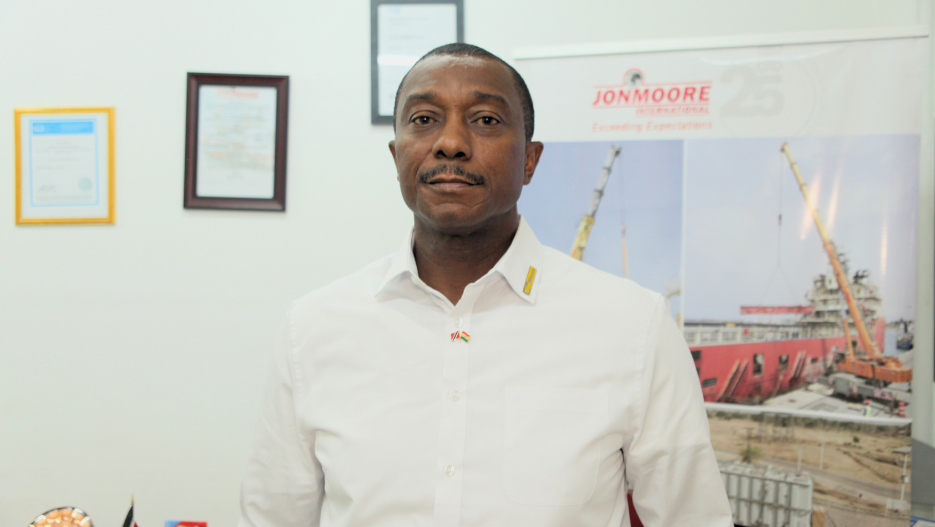
Could you provide an update on the current state of Jonmoore International and outline the scope of its operations? Since our last conversation, how has the company evolved?
Jonmoore was established in 1998, and we have now been operating for 27 years. We celebrated our 25th anniversary two years ago, and we are proud to say that our greatest strength lies in our human resources. Our team includes staff members who have been with us for 25 years and continue to contribute to our success. Additionally, several retired colleagues remain engaged with us, providing technical support and sharing their valuable experience.
Our footprints extend across the sub-region, encompassing both Francophone and Anglophone territories. We maintain a strong presence in Ghana, Côte d’Ivoire, Burkina Faso, Mali, Guinea, Liberia, and Senegal.
We continue to grow and reinforce our position as a reliable transport and project logistics solutions provider.
In addition to transportation, what other services does the company currently offer?
We provide comprehensive logistics solutions, encompassing road freight, air freight, air charters, relief transport, vessel charters, and specialised transport operations. In essence, we deliver end-to-end logistics solutions.
Lifting is also one of our core strengths. Our fleet includes cranes ranging from 80 to 450 tonnes, as well as forklifts operating in both Ghana and Côte d’Ivoire. These assets enable us to provide comprehensive lifting solutions across the mining and oil and gas sectors.
Given the high level of competition within Ghana and the broader sub-region, how does your company differentiate its services from other industry players?
Our greatest strength lies in being innovative and delivering the right solutions within budget, while always operating in the safest possible environment. Our approach prioritises two key elements: ensuring complete safety for the environment, our team, and all personnel involved; delivering solutions within our clients’ budgets and enabling them to achieve profitable outcomes.
Although we do not work with a large number of clients, the partnerships we have built are long-standing. Many of our clients, both in Ghana and outside the country, have been with us for many years.
Turning to the industry more broadly, what key trends are you observing? From your perspective, what are the major challenges and the emerging opportunities shaping the sector today?
Internally, our key strength and ongoing challenge is continuous improvement in human resources management. Continuous training is essential for us, as we strive to stay ahead of industry trends and best practices. Therefore, we invest substantially in staff training and development, ensuring our employees are well-supported and managed.
We also operate in an environment that emphasises safety and respect for the environment, which we maintain as a core principle.
In terms of external factors, industry trends play a major role in shaping how we operate. For instance, any advances in hydrocarbon developments or oil and gas discoveries in the region present opportunities for us to engage in those sectors. The same applies to advancements in mining, natural resource development and power generation. As new power plants and major infrastructure projects emerge across the region, we are often involved.
These developments have a significant influence on our growth.
In our previous interview, you highlighted Jonmoore as an asset-owned organization, describing this as part of your competitive advantage. Since then, what developments have taken place in this area? Has there been any shift or improvement in your equipment strategy or related asset investments?
We are an asset‑owned organisation, and over time, we have continually improved the quality of the equipment we acquire, ensuring it meets the highest standards for both environmental responsibility and operational efficiency. Reflecting on our progress over the past six or seven years, significant changes have been implemented.
For example, our forklifts now include zero-emission models that eliminate environmental damage and emissions. Several of our newly acquired cranes meet Euro 4 standards, bringing their emission levels close to zero. We also ensure that our operators are fully trained to handle this advanced equipment.
In addition, we are progressively upgrading our fleet of trucks to models that are safer, more efficient, and more cost-effective than those we previously used.
We are also embracing technological advancement, integrating artificial intelligence (AI) into our satellite tracking and route mapping systems. This includes enhancements that provide excellent visibility into our operations, with cameras installed both inside and outside the cabins of our vehicles.
These innovations allow for detailed and accurate reporting to clients, ensuring they are well-informed of any issues as they arise. Clients can monitor developments in real-time via their phones, iPads, or tablets.
Given these initiatives, how have they influenced the company’s overall business performance?
The most significant impact is related to capital expenditure (CAPEX). Our CAPEX requirements are high, and we often need to invest significantly in acquiring the equipment necessary to maintain our standards. This naturally increases our overall costs.
We must therefore justify spreading this CAPEX across our operating expenditure (OPEX) and pricing model to ensure we remain profitable.
The challenge is that the market is highly price-sensitive, and some clients focus solely on the bottom line, asking why they should pay more when a competitor offers the same service for less. Our challenge is educating clients on the value proposition beyond price alone. Our task is to demonstrate that while our price may be higher, the value we deliver, in terms of safety, reliability, and long-term performance, is significantly greater.
This pricing pressure has had a considerable effect on us, especially given how much we invest to stay ahead of the competition and keep pace with evolving industry standards.
I would assume that this ultimately contributes to an improved return on investment (ROI)
It does have an impact, although the effect is more gradual than it might be if we chose to operate differently. In today’s market, competition is intense. For example, when purchasing an articulated truck or tractor unit, there are options from across the world. Many of these vehicles perform similar work, yet the price difference can be as much as 100 per cent.
If a competitor acquires equipment at half the price, their capital expenditure is lower, their pay-off period is shorter, and they can afford to price more competitively. By contrast, when we decide to invest in equipment at double the cost, we do so with full justification. We know the value we are getting, particularly in terms of safety, reliability, and long-term performance.
Nevertheless, this commitment to quality can place us at a cost disadvantage, and that has been one of our biggest challenges.
Could you highlight the key projects you have completed in recent years?
The nature of our business means that we are continuously engaged in projects. We have successfully undertaken several initiatives in the mining sector across Guinea, Côte d’Ivoire, and Mali, and continue to manage several active projects.
For reasons of client confidentiality, we can only refer to these broadly as projects within the mining, oil and gas, power generation and security sectors. Specific details of clients and projects require prior approval.
Nonetheless, these engagements reflect the breadth of our footprint across the region.
Are there additional countries you are currently targeting or considering for future expansion?
We have expanded our operations beyond West Africa into new markets. In East Africa, we successfully completed projects in Tanzania and Kenya, particularly related to the African Continental Free Trade Area (AfCFTA).
We also maintain a presence in Equatorial Guinea. Although activity there has been limited, we are continuing to explore opportunities beyond the West African subregion.
Additionally, we are in the process of offering services in a Caribbean country, with expectations that operations may commence before the end of the year. This initiative pertains to the oil and gas sector, an area we have been monitoring for some time.
We have recently completed a bidding process and have been informed that we were shortlisted. The last update indicated that we have been selected, and we are now preparing for further discussions.
As you plan for the future, how do you see Jonmoore evolving over the next five years, and what initiatives will drive that growth?
Our growth strategy is intrinsically linked to infrastructure development and government policy. In the regions where we operate, major infrastructure projects are typically driven by central government initiatives and foreign direct investment policies. We actively monitor market trends and identify emerging opportunities, such as planned expansions in key sectors, to position ourselves strategically for growth.
For example, Guinea represents a significant opportunity market due to anticipated iron ore expansion projects. Rather than pursuing short-term contracts, we adopt a long-term strategic approach. Guinea is one of the markets where our presence will grow significantly in the coming years, and we are already engaging with major clients in Guinea who are developing these projects, positioning ourselves to capture a substantial market share over the next five years.
Liberia is a market we have been active in for many years, and there are new and exciting opportunities emerging. We continue to engage with authorities and the private sector to explore potential collaborations.
We are equally optimistic about Ghana, which holds significant potential. Recent reports of new offshore exploration and development fields have encouraged us to prepare strategically for future opportunities in this space.
Internally, we are also focused on strengthening our human resources. We are implementing significant changes across our managerial and technical divisions, with a strong emphasis on training and empowerment. We are bringing in new talent and providing additional training for existing staff, particularly in theoretical aspects.
We are affiliated with a network called BIGMOVE, the largest transportation consortium in Europe, which was founded in Germany. As the only BIGMOVE partner in Africa, we collaborate closely with the network to identify opportunities across the continent.
This partnership includes advanced training programmes, with staff travelling to Germany to gain expertise before returning to apply their knowledge locally. These initiatives form part of our broader projections.
How do you envision positioning Jonmoore International in the market, and do you see collaborations with investors or technical partners playing a role?
We are affiliated with a global network headquartered in Denmark, which operates 65 offices worldwide. Projects are discussed and shared across these offices, ensuring collaboration and knowledge exchange.
Through our partnership with BIGMOVE, which covers Europe, we represent the network in Africa. Together, we explore opportunities across the continent, including projects in South Africa and Mozambique. In such ventures, BIGMOVE provides equipment and technical expertise, while we contribute human resources, working jointly to submit competitive bids.
These collaborations reflect the growing footprint you will see from us in the coming years, as we continue to build more partnerships and expand our presence internationally.
Partnerships naturally require financial investment and a commitment to growth. Like many companies, we do not have extensive financial reserves. We explore opportunities for growth in collaboration with our financial institutions, identifying areas where funding is required for specific projects. When a project requires specific equipment or asset acquisition, we engage our financial institutions to secure the necessary funding. They have consistently stood by us, enabling us to strengthen our capacity and deliver on our commitments.
Before we wrap up, is there anything important that we have not covered that you would like to highlight?
I would like to acknowledge and congratulate our team. We are particularly proud of the staff members who have demonstrated long-term commitment to the organisation and played instrumental roles in our growth and success.
Across our operations in Ghana, Côte d’Ivoire, Guinea, Mali, and Burkina Faso, we maintain exceptionally low staff turnover, a testament to our organisational culture and commitment to employee development. Our people join us, become part of the family, and grow alongside the company. We celebrated this commitment and dedication with special recognition during our 25th anniversary, and we remain deeply grateful to the team.